 ultimate-guide
Resin Flooring for Wet Rooms: A 2026 Guide
Resin flooring in wet rooms: choose the right system
A resin finish can be considered for a wet room, but suitability must be established for the complete installation. A continuous appearance alone does not prove that a floor is watertight, safe when wet or suitable for a particular base.
For Puur projects, distinguish resin flooring from Puur PSR polished concrete overlay. Puur’s published guidance says PSR is unsuitable for wet rooms. It may be used in a bathroom outside the shower area, subject to assessment, and laid up to a shower tray. Do not specify PSR as the finish to a wet-room shower floor.
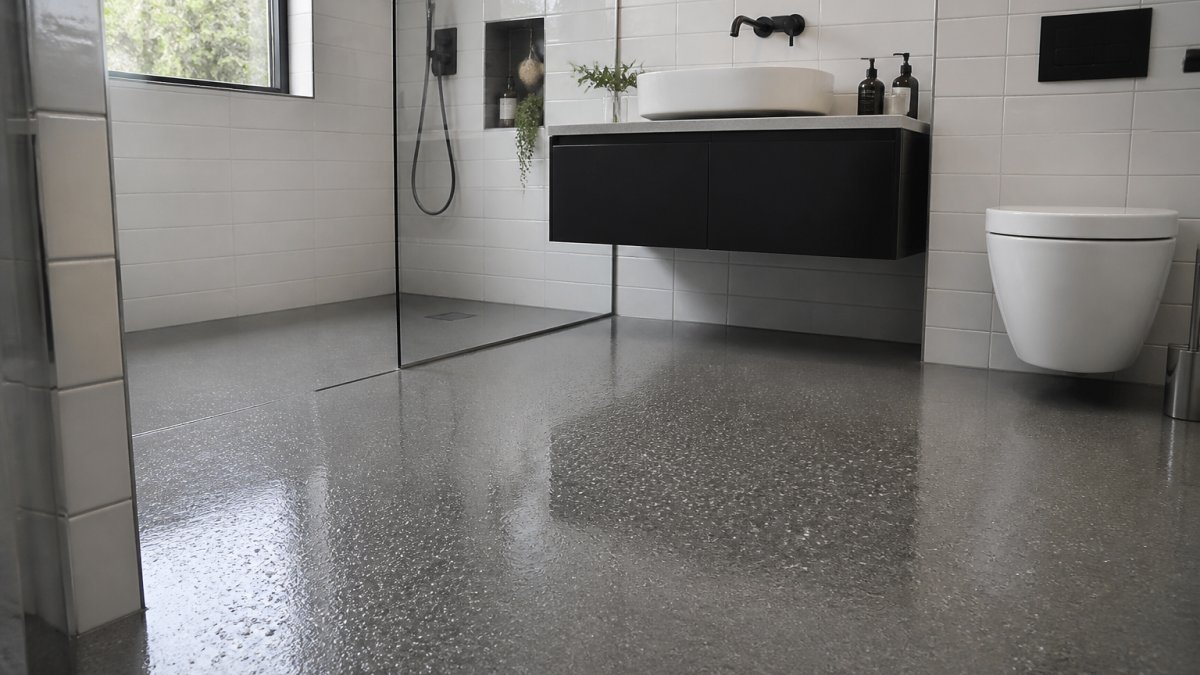
Illustrative image, not a documented Puur wet-room installation or evidence of a particular floor system’s suitability.
Waterproofing depends on the details
Agree a compatible wet-room construction before work starts. It should address the base, waterproofing, drainage connections, junctions, penetrations, thresholds and the selected finish. The decorative layer should not be treated as a substitute for that design.
Any membrane or tanking system must be compatible with the resin and the other components. Do not assume that a generic epoxy or polyurethane primer provides the required waterproofing, or that every resin floor uses the same layer sequence.
Ask the installer to confirm responsibilities for the design, installation, checking and handover of the complete assembly. Movement joints and service connections need deliberate details even where the main surface looks continuous.
Form the falls in the approved base
The floor needs an agreed drainage layout and falls that direct water to the drain. Coordinate this with the shower output, drain capacity, levels and access requirements.
Do not rely on an ordinary self-levelling decorative pour to create a drainage slope. Have the correct falls formed in the specified construction before the finish, following the selected system’s details. The drain and waterproofing connection must be suitable for the proposed finish.
Specify slip resistance for wet use
Water, soap and cleaning residues affect how a floor behaves underfoot. Ask for evidence relevant to the exact finish and intended conditions, including barefoot use where applicable.
A glossy photograph or a generic statement that resin is non-slip is not enough. Agree the texture, cleaning method and maintenance requirements together. A slip-resistant finish reduces risk; it does not remove the need to manage standing water, residues and cleaning.
Cleanability does not mean antimicrobial performance
A continuous surface reduces the number of grout joints, which can help with cleaning. Dirt, soap deposits and microorganisms can still collect on the floor and around drains and junctions.
Do not describe a standard resin finish as inherently antimicrobial, mould-proof or maintenance-free. If a project requires tested antimicrobial properties, obtain evidence for the specific product and application.
Resin and tiles: compare complete proposals
Resin offers a continuous visual finish; tiles offer a jointed layout and a wide range of sizes, colours and surfaces. Both need an appropriate base, waterproofing and drainage design in a wet room.
Compare the particular products and installed details. Neither option is automatically more durable, faster to install or easier to maintain in every project. Ask how a damaged area would be repaired and whether the repair may remain visible. Do not expect a guaranteed invisible patch.
Can it work over underfloor heating?
Confirm the proposed resin, heating and base as a compatible construction. Obtain the suppliers’ requirements for testing, moisture condition, installation, curing and restart. There is no universal warm-up time or heating-restart schedule for all resin floors.
Heating does not compensate for an unsuitable base or waterproofing design. Resolve the floor levels, drainage and heating details together before installation.
Cleaning and care after installation
- Use the cleaner, dilution and equipment approved for the installed finish.
- Remove soap deposits and residues, and keep drains clear.
- Follow the agreed cleaning frequency for actual use.
- Maintain ventilation and inspect junctions and seals as advised.
- Report damage, persistent pooling or changes in the finish to the installer.
Do not assume that ordinary bathroom chemicals, abrasive pads, steam cleaning or pressure washing are suitable. Obtain approval for the specific method. Keep to the permitted chemical contact times and rinse or dry as instructed.
Programme and cost
Preparation, waterproofing, repairs, curing and testing affect how long the room is unavailable. Ask for a project-specific programme, including the point at which shower use is permitted. Light foot traffic and full wet use may have different requirements.
A useful quotation identifies the area, base condition, drainage work, waterproofing responsibilities, finish, slip-resistance requirements and access. Avoid comparing only a headline price per square metre or relying on a generic lifespan claim.
Discuss your project before choosing the finish
Send us plans, photographs, base details and the proposed drainage and heating arrangements. We can discuss whether a Puur resin system is suitable and what needs resolving with the wet-room designer or contractor.
Ask Puur about a wet-room resin specification
Frequently Asked Questions
Is resin flooring suitable for wet rooms?
A resin system specifically suitable for the proposed wet-room construction may be an option. Confirm the base, waterproofing, drainage, slip resistance and finish together. Puur PSR polished concrete overlay is unsuitable for wet rooms and should not be used as a wet-room shower-floor finish.
Does resin flooring require a waterproof membrane?
A wet room needs an agreed waterproofing design with compatible connections at drains, walls, penetrations and thresholds. The required layers depend on the selected system. Do not assume the decorative resin alone, or a generic primer, provides a complete watertight assembly.
Is resin flooring slippery when wet?
Suitability depends on the exact surface and the expected water, soap and barefoot or footwear conditions. Specify appropriate slip-resistance evidence and a compatible cleaning routine. No floor should be described as eliminating slip risk.
How does resin compare to tiles in a wet room?
Resin gives a continuous visual finish; tiles provide a jointed layout. Both need compatible waterproofing, drainage and base preparation. Compare the specific products, appearance, care, repair options and installed costs rather than assuming either category is always superior.
Can resin flooring be installed over existing bathroom floors?
Only after assessment of stability, moisture, existing layers, drainage and available levels. The installer may need to remove or repair the old construction. Confirm that the proposed build-up can provide the required falls and waterproofing.
How do you maintain a resin floor in a wet room?
Use the cleaning products and equipment approved for the installed system. Remove residues, keep drains clear and inspect junctions as advised. Do not assume standard bathroom chemicals, abrasives, steam or pressure washing are suitable.
What is the cost of resin flooring for bathrooms?
The quotation depends on area, base condition, preparation, drainage, waterproofing, finish, slip-resistance specification and access. Ask Puur for a project-specific proposal that makes the scope and responsibilities clear.
Is resin flooring compatible with underfloor heating in wet rooms?
Some resin systems may be suitable over a correctly specified heated construction. Confirm compatibility and follow the suppliers’ testing, drying, curing and heating-restart procedures. Compatibility should not be assumed for every resin or heating system.